


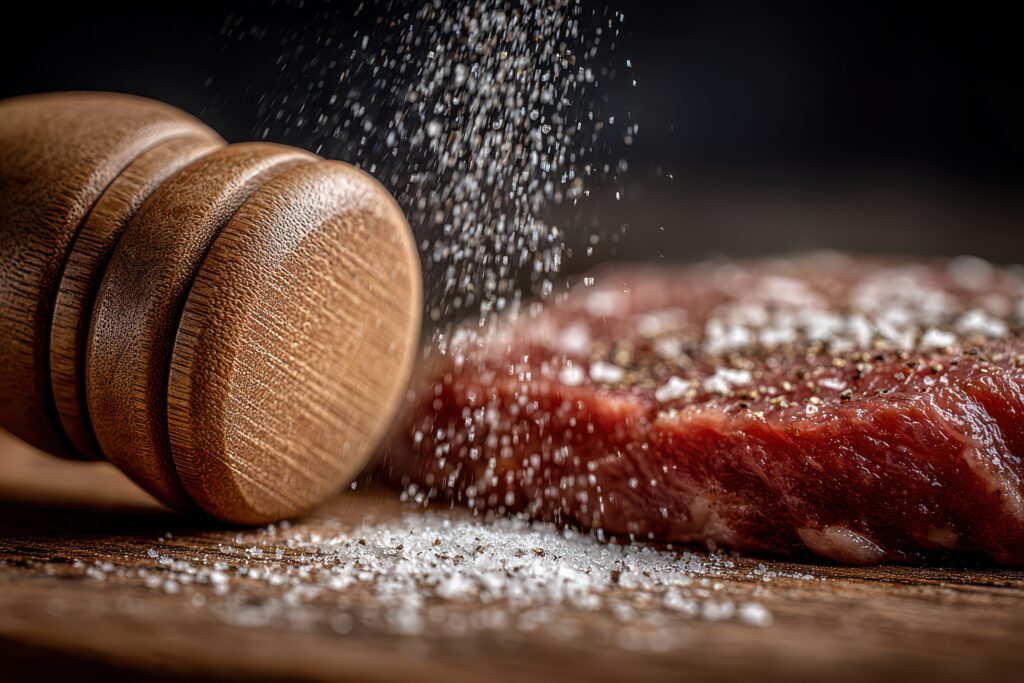
Not all seasonings are created equal. While every seasoning shares the same aspiration, to bring food to life through flavor – each one must be designed with its final application in mind. This is to say that what works beautifully on a chip or puff won’t necessarily translate to a marinade or a sausage.
In this blog, Senior Culinologist Brian Duffy explains what makes protein seasonings unique and describes the technical considerations required to build flavor systems that perform consistently and deliciously in meat and protein applications.
Designing with the End Use in Mind
Seasoning formulation begins with understanding how the end customer plans to use the product. Four core factors guide the process: usage level and application, functionality, flavor, and granulation.
Target usage level is especially critical. Salt limits, processing parameters, and functional ingredient goals all intersect here, shaping the seasoning from the inside out. For example, in sausage or whole-muscle applications, a 1.5% finished salt level is generally standard. Whether a customer intends to use a seasoning at 5% or 8% inclusion will determine that salt level upfront, and once it’s set, it’s set.
The same principle applies to functional ingredients such as curing salts, encapsulated acids, and enzymes. These components must be clearly defined early in development. Miscommunication around enzyme levels can leave a steak unacceptably tough or break it down into sludge. Errors in preservative usage can lead to spoilage, or worse. Getting these fundamentals right is essential before moving forward.
Once the functional framework is established, then the real fun can begin.
 Building Flavor through Science
Developing flavor in protein seasonings requires a thoughtful balance of structure and creativity. Foundational basic tastes (i.e., sweet, salty, sour, bitter, and umami) lay the groundwork for the entire system. Other ingredients like sugars, acids, salts, yeast extracts, and similar components lay this foundation.
Once the groundwork ingredients have been established, aromatics bring the flavor profile to life. Herbs, spices, onion and garlic, dairy ingredients, natural flavors, and countless other ingredients contribute character and complexity. When these ingredients work in harmony, the result is a protein seasoning with a craveable flavor that consumers will remember.
Why Granulation Matters
Flavoring ingredients come in many shapes and sizes, but for meat products, size truly matters.
In most applications, medium to large granulation is ideal. Visual cues like cracked black pepper or parsley flakes help signal authenticity and craftsmanship to consumers. Larger particles also perform better from a processing standpoint: they are more resistant to clumping, improve flow, and integrate more consistently during processing compared to fine powders.
Granulation isn’t just an aesthetic decision; it’s a functional one that impacts handling, performance, and finished product quality.
Bridging Innovation from Snacks to Meat
Fuchs is a leading seasoning expert and trusted partner for brands across many segments of the food industry. From snacks and beverages to proteins and beyond, we’ve been at the forefront of flavor innovation in numerous product categories.
Compared to other segments of the food industry, the meat category is still relatively early in its journey when it comes to flavor innovation.
That’s where our cross-category expertise becomes a powerful advantage. While snack seasonings and meat seasonings are built differently, the flavor trends driving innovation in the snack category offer valuable inspiration.
Our experience translating bold, emerging flavors across categories allows us to help meat manufacturers expand beyond the expected.
Whether it’s developing a well-balanced traditional Italian sausage or pushing boundaries with a black garlic umami beef stick, Fuchs brings the technical know-how and creative insight to make it happen.
Ready to create trend-forward flavors for proteins? Contact us today!